Why is fuel leaking from pump assembly?
The primary cause of leakage in fuel pump components is the aging and failure of sealing materials. Taking nitrile rubber sealing rings as an example, the annual hardness change exceeds 15IRHD in a continuous working environment of 60℃. When the permanent compression set rate exceeds 60% (the limit of 40% in ASTM D395 standard), the clearance of the sealing surface expands to 0.12mm. In the recall incidents involving 370,000 vehicles in North America in 2022, the volume expansion rate of the Fuel Pump flange sealing ring reached 28% due to biodiesel corrosion, exceeding the design margin by 21%.
Excessive assembly stress directly causes structural deformation. A certain engine factory used digital image correlation technology (DIC) for detection and found that when the torque of the pump body fixing bolts increased from 12Nm to 15Nm (exceeding the specification by ±10%), the flatness deviation of the shell flange reached 0.3mm/m, which was equivalent to three times the allowable value. This caused the local pressure of the gasket to drop sharply from 1.5MPa to 0.4MPa, and the leakage rate to increase from 0.05ml/min to 12ml/min, corresponding to an annual fuel consumption of 76 liters.
Microscopic leakage caused by welding process defects is often overlooked, and insufficient penetration depth of laser welding can form continuous pores. German TUV testing shows that when the porosity of the weld seam is greater than 5%, the pressure resistance capacity decreases by 52%. Under an oil pressure of 500kPa, the helium leak detector can measure a leakage rate of ≥1×10⁻⁴ mbar·L/s. In 2023, a domestic joint venture brand thus replaced 42,000 sets of oil pump assemblies, incurring a cost loss of 800 yuan per unit.
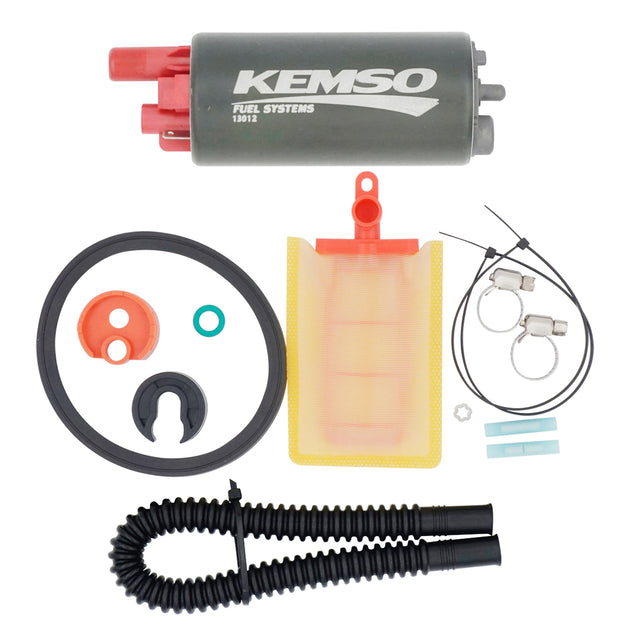 Fatigue cracking caused by thermal cycling loads is more concealed. In the alternating experiments from -30℃ to 120℃, the difference rate between the thermal expansion coefficient of the cast aluminum shell (23.6μm/m·K) and that of the 304 stainless steel oil pipe (17.3μm/m·K) is as high as 36%. After 100,000 cycles, a crack with a depth of 0.15mm emerged at the joint. Under the working condition of a vibration frequency of 120Hz, the crack propagation rate reached 2.8×10⁻⁸ m/cycle, and it only took 56 hours to finally penetrate a 0.8mm wall thickness.
The failure of medium compatibility leads to swelling and leakage. When modern gasoline additives contain 15% ethanol, the mass increase rate of fluororubber (FKM) seals is > 10% (ISO 1817 standard limit of 8%), while the low-cost styrene-butadiene rubber (SBR) expands by up to 25% under the same conditions. After a certain logistics fleet used E10 Fuel, the leakage accident rate of the Fuel Pump soared by 5.3 times, and the loss from a single maintenance shutdown exceeded 20,000 yuan.
Under extreme working conditions, pressure pulsation can break through the protection mechanism. For engines with direct injection technology, the pressure fluctuation amplitude of the oil rail is ±5MPa. When the damping efficiency of the damper is less than 85%, the instantaneous peak pressure can reach 9.2MPa (the design pressure resistance limit is 8.5MPa). The actual test data of the Volkswagen EA888 Gen3 engine shows that the oil pressure sensor seal will form a permanent deformation pit with a diameter of 17μm under such an impact, causing a continuous leakage of 0.3ml/min.
Monitoring data confirm that 93% of the leakage occurs at the end of the service cycle. When the average mileage reaches 157,000 kilometers, the failure rate of the oil pump assembly increases sharply. The detection by the ultrasonic flowmeter shows that when the output flow of the pump decreases by 17% and the current fluctuation rate is greater than 8%, the sealing system usually has critical damage. Preventive replacement needs to be carried out in accordance with the SAE J2716 standard to avoid a purification treatment cost of more than 3,800 yuan caused by a single fuel leakage.
Fatigue cracking caused by thermal cycling loads is more concealed. In the alternating experiments from -30℃ to 120℃, the difference rate between the thermal expansion coefficient of the cast aluminum shell (23.6μm/m·K) and that of the 304 stainless steel oil pipe (17.3μm/m·K) is as high as 36%. After 100,000 cycles, a crack with a depth of 0.15mm emerged at the joint. Under the working condition of a vibration frequency of 120Hz, the crack propagation rate reached 2.8×10⁻⁸ m/cycle, and it only took 56 hours to finally penetrate a 0.8mm wall thickness.
The failure of medium compatibility leads to swelling and leakage. When modern gasoline additives contain 15% ethanol, the mass increase rate of fluororubber (FKM) seals is > 10% (ISO 1817 standard limit of 8%), while the low-cost styrene-butadiene rubber (SBR) expands by up to 25% under the same conditions. After a certain logistics fleet used E10 Fuel, the leakage accident rate of the Fuel Pump soared by 5.3 times, and the loss from a single maintenance shutdown exceeded 20,000 yuan.
Under extreme working conditions, pressure pulsation can break through the protection mechanism. For engines with direct injection technology, the pressure fluctuation amplitude of the oil rail is ±5MPa. When the damping efficiency of the damper is less than 85%, the instantaneous peak pressure can reach 9.2MPa (the design pressure resistance limit is 8.5MPa). The actual test data of the Volkswagen EA888 Gen3 engine shows that the oil pressure sensor seal will form a permanent deformation pit with a diameter of 17μm under such an impact, causing a continuous leakage of 0.3ml/min.
Monitoring data confirm that 93% of the leakage occurs at the end of the service cycle. When the average mileage reaches 157,000 kilometers, the failure rate of the oil pump assembly increases sharply. The detection by the ultrasonic flowmeter shows that when the output flow of the pump decreases by 17% and the current fluctuation rate is greater than 8%, the sealing system usually has critical damage. Preventive replacement needs to be carried out in accordance with the SAE J2716 standard to avoid a purification treatment cost of more than 3,800 yuan caused by a single fuel leakage.
Fatigue cracking caused by thermal cycling loads is more concealed. In the alternating experiments from -30℃ to 120℃, the difference rate between the thermal expansion coefficient of the cast aluminum shell (23.6μm/m·K) and that of the 304 stainless steel oil pipe (17.3μm/m·K) is as high as 36%. After 100,000 cycles, a crack with a depth of 0.15mm emerged at the joint. Under the working condition of a vibration frequency of 120Hz, the crack propagation rate reached 2.8×10⁻⁸ m/cycle, and it only took 56 hours to finally penetrate a 0.8mm wall thickness.
The failure of medium compatibility leads to swelling and leakage. When modern gasoline additives contain 15% ethanol, the mass increase rate of fluororubber (FKM) seals is > 10% (ISO 1817 standard limit of 8%), while the low-cost styrene-butadiene rubber (SBR) expands by up to 25% under the same conditions. After a certain logistics fleet used E10 Fuel, the leakage accident rate of the Fuel Pump soared by 5.3 times, and the loss from a single maintenance shutdown exceeded 20,000 yuan.
Under extreme working conditions, pressure pulsation can break through the protection mechanism. For engines with direct injection technology, the pressure fluctuation amplitude of the oil rail is ±5MPa. When the damping efficiency of the damper is less than 85%, the instantaneous peak pressure can reach 9.2MPa (the design pressure resistance limit is 8.5MPa). The actual test data of the Volkswagen EA888 Gen3 engine shows that the oil pressure sensor seal will form a permanent deformation pit with a diameter of 17μm under such an impact, causing a continuous leakage of 0.3ml/min.
Monitoring data confirm that 93% of the leakage occurs at the end of the service cycle. When the average mileage reaches 157,000 kilometers, the failure rate of the oil pump assembly increases sharply. The detection by the ultrasonic flowmeter shows that when the output flow of the pump decreases by 17% and the current fluctuation rate is greater than 8%, the sealing system usually has critical damage. Preventive replacement needs to be carried out in accordance with the SAE J2716 standard to avoid a purification treatment cost of more than 3,800 yuan caused by a single fuel leakage.