Building a Body Care Line: A Step-by-Step Run Through OEM and ODM
A body care line is manufactured in a predictable sequence — brief, fragrance development, base formulation, sample approval, packaging, pilot, bulk and documentation — and almost all of the risk sits in the handovers between those stages. The way to stay in control as a buyer is not to supervise the factory but to treat each stage as a decision point where you sign a specific deliverable. This article walks through that sequence and the choices at each step, written for a product development manager planning a first body care range.
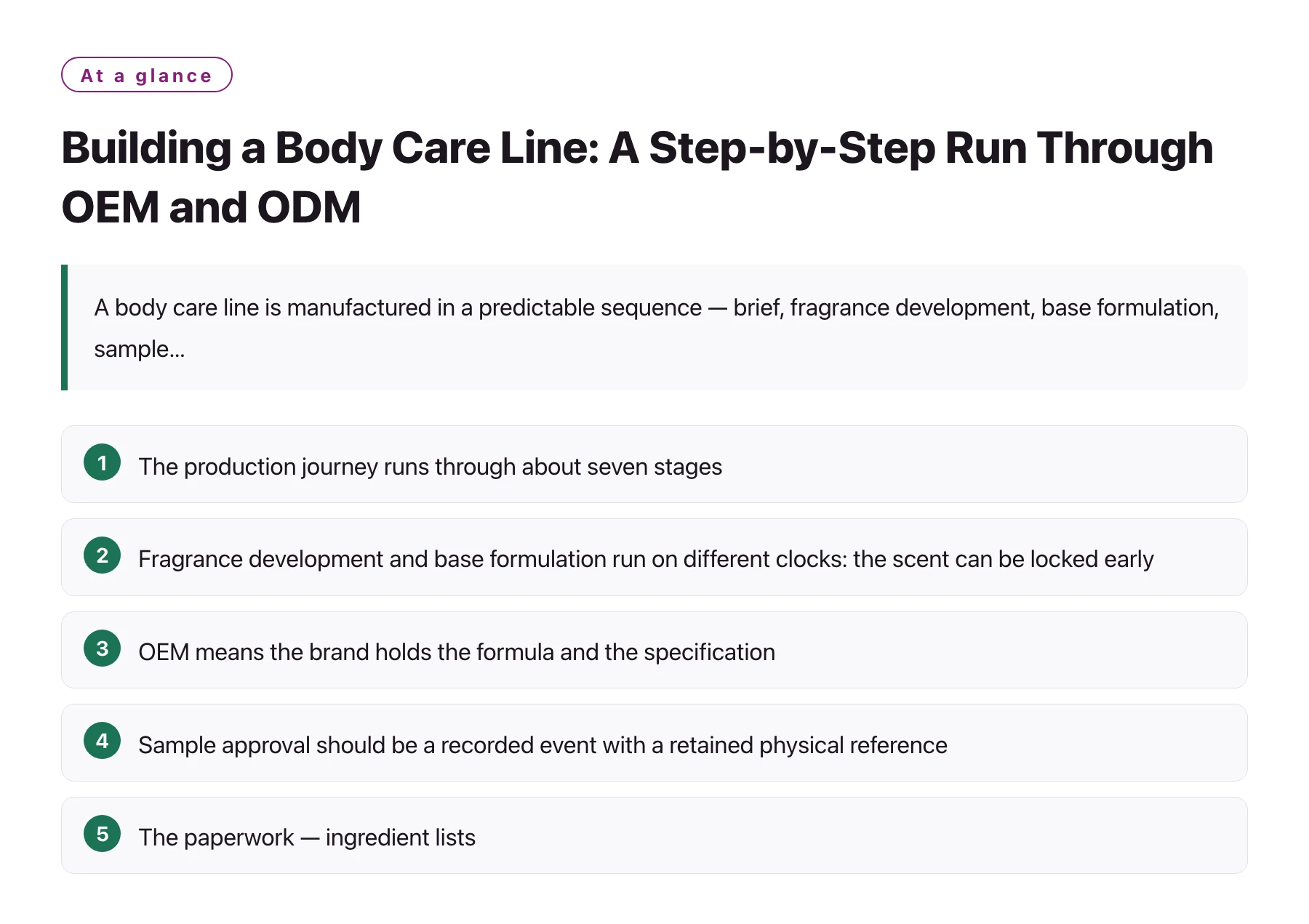
Key takeaways
- The production journey runs through about seven stages, and the buyer's job at each one is to sign a defined deliverable rather than to monitor activity.
- Fragrance development and base formulation run on different clocks: the scent can be locked early, while stability and preservative work decide when the product is actually safe to ship.
- OEM means the brand holds the formula and the specification; ODM means the manufacturer develops from a brief — and for body care that choice also decides who owns the base formulation.
- Sample approval should be a recorded event with a retained physical reference, never a comment on a photograph.
- The paperwork — ingredient lists, allergen declarations, market notifications — is part of the process, and the destination markets have to be chosen before the label artwork is started.
From the outside, body care manufacturing looks like a single opaque activity: you hand over a concept and a factory returns pallets. In practice it is a chain of about seven stages, and each stage ends with a deliverable that somebody has to approve. The brands that get into trouble are rarely the ones with a slow factory; they are the ones with no one assigned to the handovers.
The practical way to approach a first range is to walk the sequence once on paper before you commit to anything, so you know which decisions you will be asked to make and when. What follows is that walk, with the choices a product development manager actually faces at each stage.
The seven stages, and who signs what
- Kickoff briefDecide the category (lotion, body wash, oil, mist), the destination markets, the pack format, the claims and a rough volume. Deliverable: a signed one-page brief. This is the cheapest stage and the one most projects skip.
- Fragrance developmentThe brief goes to the perfumer for two to three directions. The scent reference is agreed on its own before the base work starts. Deliverable: an approved scent reference, not a finished product.
- Base formulationFor lotions, gels and cleansers the manufacturer builds the base around the scent, the preservative system and the texture. Stability and microbial testing begin here. Deliverable: a formula sheet and a test plan.
- Sample assembly and approvalThe scent, the base and the pack are combined into a product sample. Approval is a recorded event: a retained physical sample, dated, with a batch reference held by both parties.
- Packaging, decoration and artworkComponents are ordered and labels are produced. Ingredient naming, allergen declaration and claims are locked to the chosen markets at this stage, because redrawing a label later costs a week everyone forgets to budget.
- Pilot batch and qualificationA small run at production scale confirms the approved sample can be repeated: fill weight, texture, scent and pack fit. Deliverable: a signed pilot report.
- Bulk production, filling, testing and documentationThe full run is produced and filled, QC checks are run, and the document pack — batch record, certificate of analysis, ingredient and allergen data, notification references — is assembled with the shipment.
The buyer's sign-off at each stage
| Stage | What you sign | What usually slips |
|---|---|---|
| Kickoff brief | Category, markets, pack, claims, volume | Projects skip this and rediscover the decisions at stage five |
| Fragrance development | Approved scent reference | No reference kept, so reorders drift |
| Base formulation | Formula sheet and test plan | Stability testing not budgeted into the timeline |
| Sample assembly | Retained physical sample | Approval given from a photograph |
| Packaging and artwork | Locked label and components | Market chosen after the label was printed |
| Pilot batch | Signed pilot report | First bulk treated as the pilot |
| Bulk and documentation | Batch record and document pack | Documents produced late, holding up customs clearance |
Read the middle column as a to-do list and the third column as a list of insurance policies. Every failure in the third column is a decision that was left open, not a machine that broke.
Where body care differs from fine fragrance
If you have run a perfume project before, most of the sequence above will look familiar. What differs is the second track, the base, and it is where body care schedules quietly expand. A fine fragrance is mostly alcohol and concentrate; a lotion is an emulsion that has to stay stable, resist microbial growth and feel right on skin, and those requirements are what the formulation stage is really about.
Leave-on, rinse-off and the use limits
The same aroma chemical is restricted differently in a fine fragrance, a leave-on lotion and a rinse-off body wash, because the categories are defined by how the product is used and the restrictions are set per category in the IFRA standards [1]. A scent that is perfectly usable in a perfume therefore cannot be assumed to work at the same level in a body product; the re-development is small but it is real, and it is one of the reasons a body care range should not share a fragrance brief with a perfume project.
Preservatives and pH drive the real timeline
The scent can be locked in stage two. The product cannot ship until the emulsion has sat through its stability period and passed microbial testing, and test work takes the time it takes — a certificate produced early is a certificate that does not describe the goods. This is exactly the kind of traceability a cosmetics GMP framework such as ISO 22716 is designed to make routine, and testing laboratories work to that framework when they evaluate cosmetics and personal care products [2].
Labels on body care carry more than the scent
A body care label lists ingredients, allergens and usage instructions, and the rules are not the same everywhere. If the EU is a destination market, the notification step is part of the market's cosmetics rules and should appear in the supplier's standard file rather than being discovered at customs [3]. None of this is hard; it is just earlier than most first-time buyers expect it in the timeline.
OEM or ODM, and what it changes in the steps
The sequence is the same under either model; the difference is where the formula comes from and who answers if it does not behave. Under OEM the brand supplies the formula or a specification detailed enough to build one, so the base formulation stage is the brand's responsibility in effect. Under ODM the manufacturer develops the scent and the base from the brief, which lowers the entry cost and shortens stage two — with the trade that the starting point may be shared unless exclusivity is negotiated.
For a first body care range the honest recommendation is to let the manufacturer own the development unless the formula is the point of the business. A brand that is entering body care to extend a perfume line usually holds its scent; a brand entering the category fresh usually does not, and paying for a bespoke base it cannot yet exploit is the kind of cost that shows up in the first P&L.
Once the model is chosen, the one structural question left is whether everything happens under one contract. For a range with several formats and one scent, keeping the fragrance, the base and the fill under one scope removes a whole class of handover risk, because the internal transfers are the manufacturer's problem rather than yours. That is the scope a supplier describes when it offers custom fragrance manufacturing, and it is worth comparing that quote against a split arrangement before deciding.
When two or three suppliers make sense
A brand that already has a fragrance partner, or that wants the formula and the base developed by different specialists, can split the stages across suppliers. It works, and it can produce a better product — but the brand becomes the integrator, which means naming the person who owns each handover. The schedule will otherwise find the gap between the suppliers.
Reading the first supplier's answer
When you run this sequence past a candidate supplier, the answer tells you more than the quote. A supplier that separates the fragrance track from the base track, asks which markets you are selling into before quoting a date, and hands over the ingredient and allergen data with the first samples is describing a process it runs often. A manufacturer that publishes its certification list and service scope makes this check faster, because there is something concrete to test against — a company such as Xuelei that states its ISO 22716 and related certifications openly is easier to verify at this stage than one that answers questions with meeting-room confidence.
The contract that keeps the file together
The final piece is the contract structure if the range sells under your own name. For a brand that wants the label, the formula rights and the packaging questions settled in one negotiation, the arrangement is closest to working with a private label partner for perfume lines, which bundles the pieces a first body care range needs and keeps the reorder file in one place.
Whatever the structure, the tests at the end of this process are simple: can the manufacturer reproduce the approved sample at volume, can it hit the quoted lead time, and can it produce the paperwork the markets require? If the answer to all three is yes on a pilot batch, the second order will be boring — and boring is the goal.
The cheapest insurance in this entire process is a one-page charter signed at kickoff: category, destination markets, pack format, claims, the approval reference and the name of the person who signs. It takes an hour to write, and nearly every delay on this list is a decision the charter should have forced.
Sources
- IFRA Standards Library (International Fragrance Association) —— The IFRA Standards Library lists the restrictions the fragrance industry applies to individual fragrance ingredients, based on safety assessments; it is the reference point for compliant fragrance formulation.
- SGS: Cosmetics, Personal Care & Household Testing —— Testing, inspection and certification services for cosmetics and personal care, including microbiological, stability and safety testing aligned with cosmetics GMP.
- European Commission: Cosmetics in the EU —— The European Commission's overview of EU cosmetics rules, including the responsible person, product information file and safety report requirements.
Frequently asked questions
How long does a body care line take from brief to shelf?
Plan in months rather than weeks, and ask the supplier to split the timeline into fragrance development, base stability and testing, component production and filling. The stability leg is the one that resists compression, so the honest question is how long the base is held in testing, not how fast the factory can fill.
Should a first body care range use OEM or ODM?
ODM unless the scent is the point of the business. ODM lets the manufacturer develop the scent and the base from the brief, which lowers the entry cost and shortens development; the trade is that the starting point may be shared unless exclusivity is negotiated. OEM makes sense when you hold a formula you intend to defend.
Which sample should I approve — the scent or the product?
Both, but separately. Approve the scent reference on its own early, then approve the combined product sample (scent plus base plus pack) later as the production reference. The retained physical sample from the approved batch, sealed, dated and batch-numbered, is what later reorders get compared against.
Can the same fragrance be used in a perfume and a body lotion?
Only after re-development. The use limits for individual fragrance materials are set per product category, and a lotion has emulsion stability and preservative requirements a perfume does not. Treat the two products as separate development projects that share a family resemblance, not as one formula poured into different packs.
What documentation should the first order deliver?
The ingredient and allergen list, the formula or specification sheet, a certificate of analysis for the batch, the batch record, any market notification references that apply, and a stability summary. Ask for the list in writing before the first order and make it part of the acceptance criteria for the shipment.